

Ancient Tech for Modern Magic: Part I
A four-part inquiry into why we are compelled to draw the unseen into form and what a medieval cosmogram can still teach us today.

If you’ll indulge me, I want to take you on a four-part journey into a paradox that has haunted human consciousness from the very beginning. The moment we became aware that we are aware, we crossed an invisible threshold. We became both the watcher and the watched, subject and object, inside the world and standing just outside it.
That crossing gave rise to wonder and also to danger. To art, ritual, and magic, but also to fixation, control and illusion. The same consciousness that marvels at the unseen also longs to stabilise it, to name it, to shape it and make it usuable. The magician becomes a technician of the sacred, walking the knife-edge between revelation and control. From that moment on, every attempt to make meaning has carried a risk: whatever begins as a doorway might quietly become a cage.
This inquiry traces how that paradox has been held, not resolved, through geometry, ritual space and sacred architecture, and why those ancient forms still speak to us now.
It is the same paradox that lingers at the centre of every magical act, every spiritual practice, every attempt to draw the unseen into the world of form.
It began with a question that had been circling the edges of my mind for weeks: What happens when the sacred is coaxed into form? When does magic open us, and when does it quietly become a trap of our own making? Then I came across a statement (I can’t recall who said it), “If you want to play with magic, you need to be someone who sees reality with a question mark at the end of the word”.
Something in me shifted. The line clarified what I had been circling: the magician archetype, the one who holds the unseen in one hand and the real in the other, forever walking the narrow bridge between revelation and possession. Maybe it was Mercury recently slipping into the alchemy of Scopio retrograde, or maybe it was simply time, but the more I followed that thread, the more I sensed a geometry beneath my thoughts: the open palm of wonder on one side, and the closed fist of material certainty on the other. I realised that this tension isn’t new at all. We have been building practices and physical ritual architectures around it for centuries, entire cosmograms that don’t answer the paradox so much as frame it, inviting us to consider what is gained, and what is lost, when the unseen brushes the world of form.
Once you start seeing this tension between the unseen and the world of form, you begin to notice how many cultures have tried to hold it in physical places. Stonehenge with its solar and lunar alignments. Gothic cathedrals carrying those same celestial mappings into soaring geometry and light. Buddhist stupas shaped as mandalic diagrams of the cosmos. Islamic architecture where repeating patterns unfold like infinite breath. Even ancient temple floors patterned with circles and squares. They’re all variations of the same impulse: to build something that can meet the sky halfway. And it’s that wider thread that eventually led me to the Cosmati Pavement in Westminster Abbey, a place where this paradox isn’t just hinted at, it’s inscribed directly into the floor.
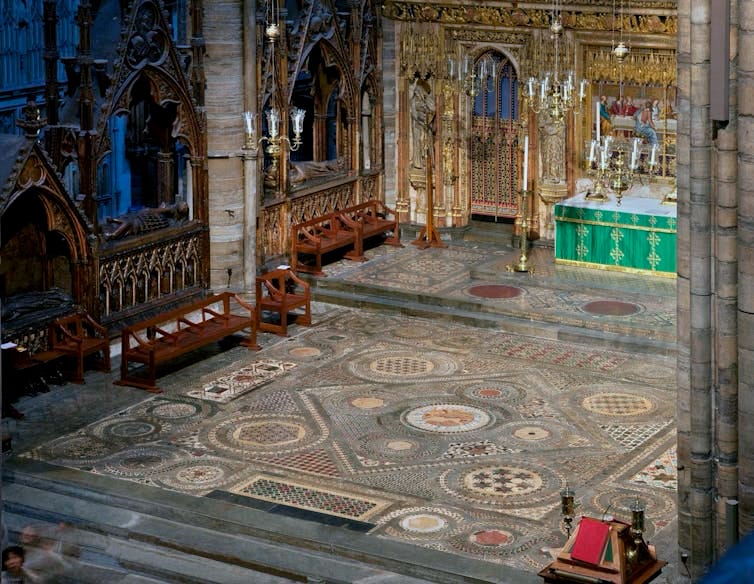
The Cosmati Pavement is one of the most striking expressions of this impulse I’ve ever encountered. At first glance it looks like an ornate medieval mosaic laid beneath the coronation throne. But the longer you sit with it, the more it reveals itself as something else entirely: a geometric meditation on the meeting point between heaven and earth. Circles nested inside squares. A central roundel reflecting the harmony of the spheres. A mathematical riddle running the perimeter. Musical proportions rising through the throne above it. Every element is working to articulate the tension I’d been circling just like a conversation between the visible and the invisible, set directly into the stones.
It wasn’t scholarship that brought me to the Cosmati Pavement. My connection to it began long before I ever stepped into Westminster Abbey or learned a single geometric principle. It started with something far stranger, a moment that only later revealed itself as part of a much older pattern. If anything, it felt less like an intellectual discovery and more like being caught inside a conversation that seemed to move through time itself, one of those Chiron-like experiences where past, present, and future blur at the edges. At the time, I didn’t have language for any of that. I only knew that the pavement had reached toward me long before I ever reached toward it.
⚷
A brief aside on Chiron:
Astrology often reduces Chiron to the familiar trope of the “wounded healer,” but its significance runs deeper. With its strange elliptical orbit between Saturn and Uranus it has long been understood as a threshold body, offering a doorway between the past and the future. Melanie Reinhart describes Chiron as “a bridge between the visible and invisible realms, linking Saturn’s world of form and memory with Uranus’ principle of awakening and future possibility.” Its elliptical orbit tells the story: not a closed circle, but a looping passage between what has been and what is yet to come. Some esoteric traditions describe Chiron as a force that opens cycles, reveals temporal seams, and exposes how time can fold back on itself. Plato once called time “the moving image of eternity” and my experience is that Chiron is one of those symbols through which our most intimate relationship with time (memory, destiny and becoming) mysteriously reveals itself.
⚷
It was 2012 when the pavement first found me. I was living in Colorado at the time and happened upon a documentary about Westminster Abbey. They had just lifted the carpet that had covered the Cosmati Pavement for decades, and the presenter mentioned a riddle written around its edges. A riddle, he said, that was meant to reveal the year the world would end. Naturally, my curiosity was piqued with all the 2012 doomsday predictions and I remember pausing the piece and doing a quick search, curious to see whether anyone had tried to make sense of it. Within minutes I’d found a neat mathematical explanation of the answer, but instead of clarifying anything it only made the riddle feel stranger. I filed the whole episode away as an odd curiosity and carried on with my life. I certainly had no inkling that I would one day be living in the UK, let alone studying sacred geometry as part of my astrological practice. So when, years later, I signed up for a workshop on drawing patterns from the Cosmati Pavement, it felt like nothing more than following a hobby. It wasn’t until I was sitting in that class at Dartington Hall that the memory of the riddle returned, suddenly and vividly, as if the floor had been waiting for me to come back to it.
The riddle itself was strange, sort of like Chiron, part chronology, part cosmology, part barely decipherable medieval numerology. Only fragments of the Latin survive on the pavement today, but an early transcription preserves its meaning. After noting the year and the craftsmen who laid the mosaic, it shifts abruptly into a sequence of lifespans: a hedge lives three years, then dogs, horses, men, stags, ravens, eagles, and whales, each creature tripling the years of the one before. The final line concludes with “the world,” as though the pattern extends outward until time itself runs out.
The text survives through three damaged inscriptions, originally formed of brass letters and copied in the fifteenth century by the Abbey chronicler John Flete. The Latin inscriptions can be translated as follows:
In the year of Christ one thousand two hundred and twelve plus sixty minus four, the third King Henry, the city, Odoricus and the abbot put these porphyry stones together.
If the reader wisely considers all that is laid down, he will find here the end of the primum mobile; a hedge (lives for) three years, add dogs and horses and men, stags and ravens, eagles, enormous whales, the world: each one following triples the years of the one before.
The spherical globe here shows the archetypal macrocosm.
Scholars have long interpreted this as a symbolic calculation of the world’s lifespan, a kind of numerical cosmology embedded in stone. In 2012, when the documentary presenter claimed the riddle predicted “the end of the world,” it was easy to understand why the idea had taken hold.
What stayed with me in that documentary wasn’t only the strange sequence of lifespans, it was the number the presenter arrived at once he applied the riddle’s tripling logic: 19,683. He joked that if this number represented “the year the world ends,” then we had far more time than anyone feared in 2012. But something about the number itself held my attention. A quick search, back when the internet still worked and provided helpful results, led me to a small mathematical curiosity called a Dudeney number discovered (or more likely rediscovered) in the early 20th century: a rare integer whose digits add up to its own cube root. There are only six of them in existence. And the last one of them is 19,683- yes the same sequence hidden inside this medieval riddle. Henry Dudeney, incidentally, was an English author and puzzle-maker known for developing “verbal arithmetic.” If that isn’t its own kind of magic, then I’m not sure what is.
So there it was: the medieval riddle’s “end of the world” pointed not to a date at all, but to the mathematical shape of a cube. When I realised this, nothing mystical happened; I didn’t suddenly “understand” the pavement. If anything, it made the whole thing more confusing. All I knew was that the riddle seemed to be pointing toward a perfect cube, and at the time that only led me into the muddled territory of online theories about “cube worship” and Saturn symbolism, interpretations with little grounding in history or geometry. I didn’t know what the cube meant, or why the number mattered. I just knew the riddle wasn’t predicting the end of the world. Beyond that, I was completely in the dark.
It would take more than a decade for any of this to make sense. In 2012, the cube was simply a dead end, pun intended, a curious mathematical detail with nowhere to go. I didn’t yet understand its symbolic lineage, or how deeply it appears in sacred architecture, or why the pavement might be invoking it at all. That clarity would come later, in a place I could never have predicted.
Looking back now, I can see how thoroughly modern misunderstandings had obscured the cube’s meaning for me. The internet was full of theories claiming that cultures “worship the cube,” often pointing to sacred sites like the Kaaba in Mecca without recognising the profound historical and spiritual meanings embedded in its form. In nearly every esoteric system, the cube is not a symbol of doom but of incarnation, stability, and the grounding of the divine into matter. Only years later did I understand that the cube was never meant to stand alone. In every sacred tradition, it is held within a circle — the bound inside the unbounded, matter inside the divine, the alchemical marriage of the masculine and the feminine. The riddle wasn’t pointing to an ending at all; it was describing the moment the unseen is drawn into form, when the infinite allows itself to take shape.
A merging, not a catastrophe.
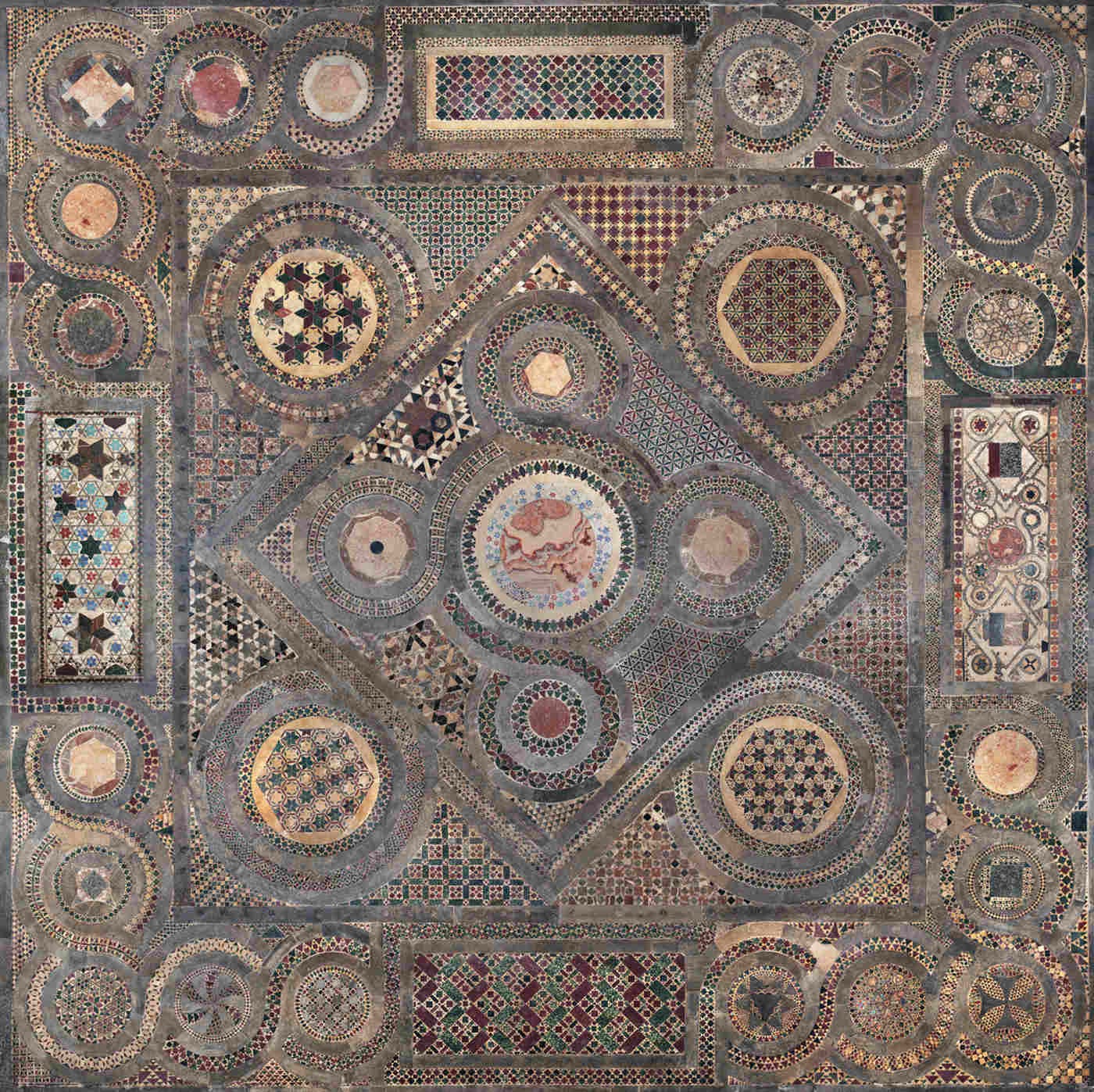
It wasn’t until the Libra Eclipse of 2023 that the thread from 2012 resurfaced with any force. I had signed up for a workshop on drawing the geometric patterns of the Cosmati Pavement (more out of personal interest than any sense of destiny) and found myself in a quiet room at Dartington Hall, surrounded by compasses, rulers, and students creating patterns of circles into squares. The teacher mentioned, almost in passing, that there was also a riddle around the edge of the pavement, though he wasn’t planning to cover it. Something in me stirred. I realised, almost with a start, that I still remembered the sequence, the number, the strange detour into cube logic. When I asked whether he intended to speak about it, he said he hadn’t found a meaningful interpretation. So I told the group what I had found all those years ago — the Dudeney number, the cube, the way the riddle didn’t point to an apocalypse but to a structure. For a moment the room fell quiet. The teacher recognised that the cube completed a geometric line of reasoning he had been developing for years. He asked if he could credit me in his book. What struck me most wasn’t recognition, but the timing, the sense of a message completing a circuit, delivered by a version of myself who had no idea who would one day need it.
By the time I left Dartington Hall, it was clear that what I had stumbled into in 2012 was only the first layer of a much larger pattern. The cube was just one thread in a far more intricate design, a design the pavement has been holding for more than eight hundred years. Part II picks up this thread, turning toward the geometry itself: the circles inside squares, the musical proportions, the cosmogram at the centre of the coronation floor, and the strange way it mirrors the very paradox I began with. The surface story is remarkable enough. The deeper one is stranger still.
This is Part I of a four-part series, Ancient Tech for Modern Magic. If you’d like to receive the next parts as they’re released, you can subscribe below.